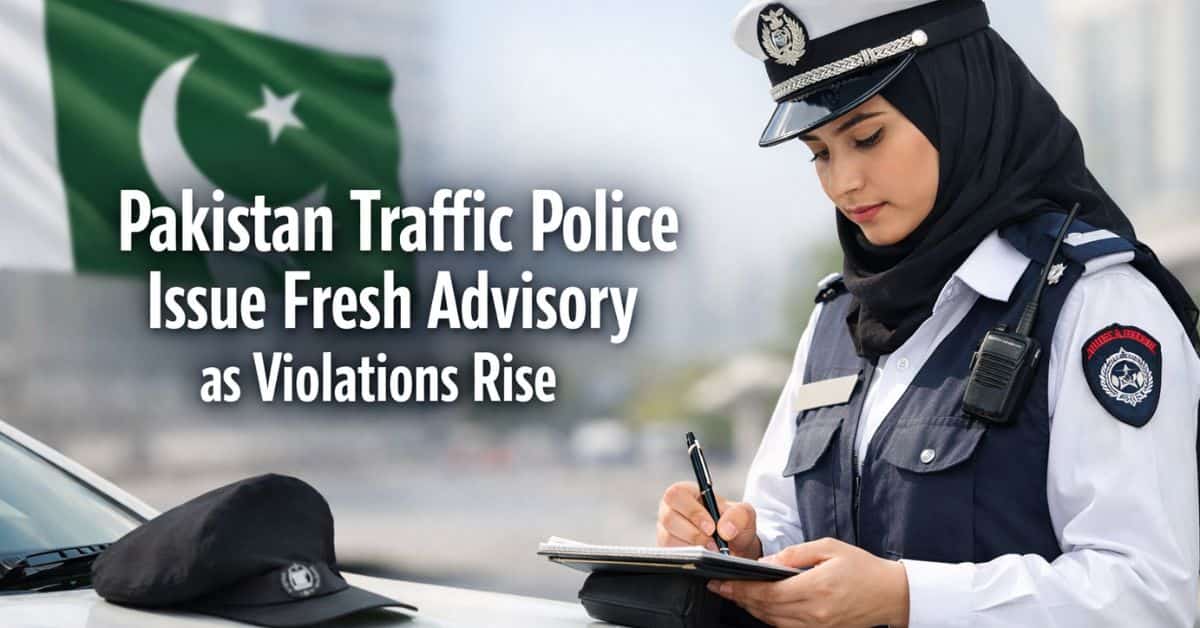
Traffic Police Issue New Advisory in Pakistan has issued a nationwide alert as road safety authorities address a significant rise in traffic violations, road accidents, and hazardous driving practices across major cities and highways. With the commencement, traffic police agencies in Punjab, Sindh, Khyber Pakhtunkhwa, Islamabad, and Balochistan have collaboratively issued revised advisories aimed at decreasing fatalities, enhancing compliance, and promoting discipline through more rigorous monitoring.
The updated advisory emphasizes speed regulation, the enforcement of helmet and seatbelt usage, lane discipline, weather-dependent driving restrictions, and the increased deployment of AI-driven traffic monitoring systems. Authorities caution that non-compliance will lead to substantial penalties, electronic challans, license suspensions, and, in severe cases, vehicle impoundment.
Why Traffic Police Issued a Fresh Advisory in Pakistan 2026?
Traffic authorities state that the recent advisory was issued in response to concerning data indicating a consistent increase in violations. These violations comprised excessive acceleration, signal violations, non-compliance with helmet regulations, wrong-way driving, and the use of mobile phones while operating a vehicle.
The primary grounds for the advisory are as follows:
- Rise in nationwide fatal traffic incidents
- Inadequate adherence to helmet and restraint regulations
- Increasing misuse of service roads and improper lane discipline
- Fog, pollution, rain, and snowfall contribute to an increased risk of accidents
- Expansion of artificial intelligence cameras detecting additional violations
According to traffic police authorities, enforcement alone is insufficient; public awareness and behavioral modifications are essential for saving lives.
Major Traffic Violations Rising Across Pakistan:
The advisory emphasizes specific violations that have surged in recent months:
Over-Speeding on Urban Roads and Motorways
Despite plainly indicated speed limits, drivers persist in exceeding them, particularly on signal-free corridors and highways. Excessive racing continues to be the primary cause of fatal accidents.
Helmet and Seatbelt Non-Compliance
Motorcyclists not wearing helmets and occupants of vehicles neglecting seatbelt use represent a significant concern. Traffic authorities report that violations related to helmet usage alone result in thousands of challans issued daily.
Signal Breaking and Lane Violations
Red-light violations, unlawful lane shifts, and intersection blockages have contributed to heightened congestion and a rise in accidents in major cities such as Lahore, Karachi, Islamabad, and Peshawar.
Mobile Phone Use While Driving
The use of mobile phones for making calls, sending texts, or viewing videos while driving has become a significant hazard, now effectively monitored through AI camera systems.
Key Instructions in the Traffic Police Advisory:
The Traffic Police Advisory Pakistan 2026 outlines clear instructions for all road users:
- Adhere strictly to the posted speed limits on roads and motorways.
- Compulsory helmet wearing for both rider and passenger
- Wearing a seatbelt is mandatory for all occupants, both in the front and rear seats of the vehicle.
- Strict enforcement against signal violations
- Prohibition of mobile phone use while operating a vehicle
- Utilize appropriate indicators and adhere strictly to lane discipline.
- Absolutely, here is the revised text: Avoid engaging in wrong-way driving under any circumstances.
Authorities emphasize that ignorance of rules will not be accepted as an excuse.
AI Traffic Enforcement Expanded in Pakistan 2026:
One of the most notable advancements highlighted in the advisory is the augmentation of AI-driven traffic enforcement.
AI systems are now capable of detecting:
- Over-speeding through ANPR cameras
- Helmet and seatbelt violations
- Signal jumping
- Illegal lane changes
- Mobile phone usage
- Number plate tampering
These systems autonomously produce electronic challans, leaving minimal scope for contention. Traffic authorities indicate that automation has diminished human error and enhanced transparency.
Weather-Based Traffic Restrictions Included in Advisory:
The 2026 advisory additionally establishes weather-specific guidelines, particularly during periods of fog, smog, rain, and precipitation.
Motorists are recommended to:
- Utilize fog lamps exclusively in conditions of dense fog.
- Decrease your pace and uphold a safe following distance.
- Refrain from non-essential travel during periods of severe weather alerts.
- Adhere to motorway police directives regarding road closures.
- Verify traffic conditions prior to undertaking extended journeys.
Failure to adhere to weather advisories may lead to fines or mandatory road closure for safety considerations.
Check Also: Traffic Fines Increase in Pakistan
New Penalties and Fines Under Traffic Rules:
Traffic authorities have issued a warning that penalties will be rigorously enforced without prior notice in numerous instances.
Typical sanctions encompass:
- Heavy fines for helmet and seatbelt violations
- Increased fines for repeated over-speeding
- License suspension for habitual offenders
- Vehicle impoundment for dangerous driving
- Black points added to driving licenses
Officials state that repeat offenders will face escalating penalties.
Advisory for Motorcyclists in Pakistan:
Motorcyclists continue to be the most at-risk demographic on the roadways. The advisory explicitly recommends that cyclists to:
- Wear adequately secured, certified helmets
- Ensure that all pillion riders also wear helmets.
- Refrain from exceeding the speed limit and making abrupt lane alterations.
- Utilize the side mirrors and signal indicators.
- Possess a valid driver’s license and vehicle registration.
Traffic authorities indicate that the majority of fatal incidents involve motorcyclists, underscoring the importance of adherence to safety regulations.
Advisory for Car Drivers and Commercial Vehicles:
Motor vehicle operators, including those engaged in ride-hailing services, as well as bus and lorry drivers, are advised to:
- Verify the vehicle’s roadworthiness and brake system condition
- Adhere to lane discipline while traveling on highways
- Refrain from overburdening
- Pause for leisure periods during extended travels
- Adhere to posted speed limits, particularly in the vicinity of schools and hospitals.
Commercial drivers will be subject to more rigorous inspections under the new advisory.
Role of Public Awareness in Reducing Violations:
Traffic authorities emphasize that enforcement alone is insufficient to resolve the issue. Public collaboration is vital.
Authorities intend to:
- Initiate campaigns to promote awareness of road safety
- Utilize social media platforms for providing traffic updates.
- Instruct students and novice drivers
- Foster a culture of defensive driving
The goal is to reduce accidents, not just issue challans.
How Citizens Can Avoid Traffic Violations:
Drivers can protect themselves by:
- Adhering to traffic regulations consistently
- Regularly verifying vehicle documentation
- Monitoring electronic challan portals
- Staying informed about traffic advisories
- Driving with patience and responsibility
Traffic police remind citizens that responsible driving safeguards not only individual lives but also the well-being of entire families.
Future Impact of the Traffic Police Advisory Pakistan:
Authorities believe that strict implementation of the advisory will lead to:
- Decrease in traffic accidents and resultant fatalities
- Enhanced traffic management within urban areas
- Enhanced enforcement of regulations on highways
- Enhanced confidence in digital enforcement mechanisms
If compliance improves, Pakistan could see long-term improvements in road safety standards
Conclusion:
The 2026 traffic advisory in Pakistan targets rising violations and road accidents through stricter enforcement, AI monitoring, and public awareness. It emphasizes helmets, seatbelts, speed limits, lane discipline, and weather-specific precautions for all road users. Strict compliance is expected to reduce fatalities, improve traffic management, and foster safer driving nationwide.
Frequently Asked Questions:
Are helmets and seatbelts mandatory?
Yes. Helmets are compulsory for riders and passengers, and all vehicle occupants must wear seatbelts at all times.
Why was the 2026 traffic advisory issued?
It was issued in response to rising traffic violations, accidents, and unsafe driving behaviors across major cities and highways. Authorities aim to reduce fatalities and improve road discipline.
How does AI traffic enforcement work?
AI systems monitor speed, helmet and seatbelt use, lane discipline, signal violations, mobile phone usage, and number plate tampering. Electronic challans are issued automatically.