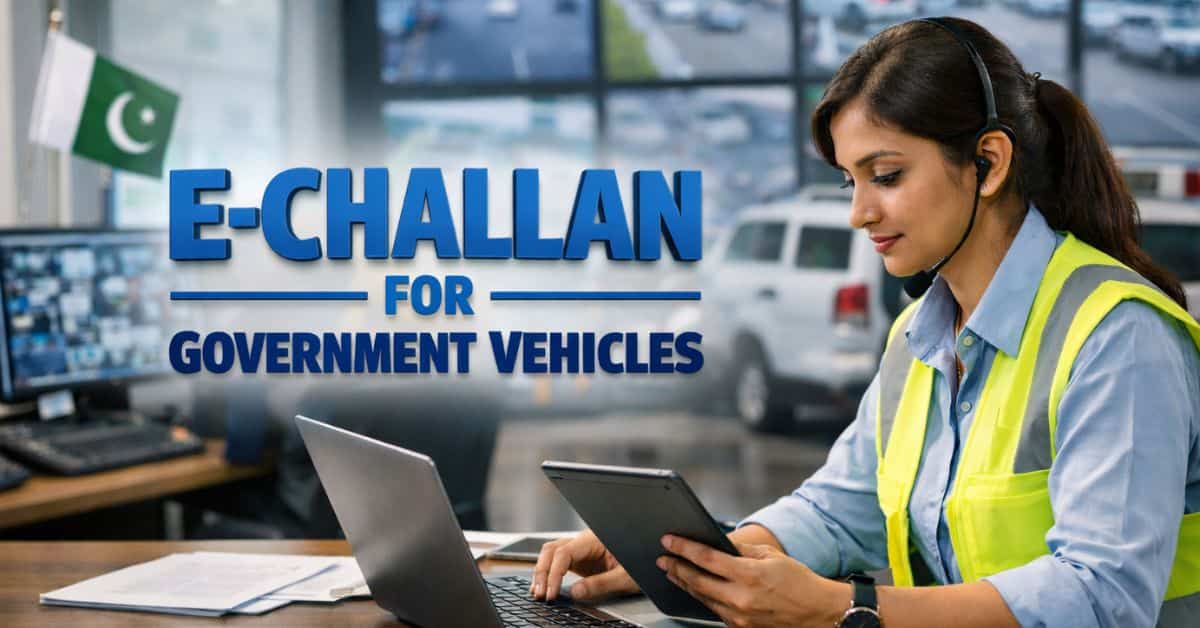
The e-challan system for government vehicles has officially been implemented in Sindh, signifying a significant change in the management of traffic violations throughout Karachi. This new directive seeks to establish accountability, enhance road safety, and dispel the longstanding perception that official vehicles are immune to penalties.
Under this revised policy, any government-owned vehicle found to be in violation of traffic regulations will be issued an electronic challan, identical to that issued to private vehicles. More importantly, the officer or employee operating that vehicle shall bear personal responsibility for the payment of the sanction.
Why the E-Challan for Government Vehicles System Matters?
The initiative is a component of a continuous endeavor to enhance traffic regulation throughout the province. A formal notification issued by the Sindh Services, General Administration, and Coordination Department affirms that these e-challans shall be implemented in accordance with Section 116A of the Traffic Ordinance 1956.
Here is the implication of the new regulation for government drivers:
- No formal exemption from traffic penalties
- Transparent oversight of violations
- Individual Responsibility for Penalties
- Enhanced safety and adherence to regulations on the roads
Traffic Offenses Covered Under E-Challan for Government Vehicles:
Numerous common violations are now systematically monitored by surveillance cameras and traffic monitoring systems. The electronic challan for government vehicles pertains to violations such as:
- Operating a vehicle without wearing a seatbelt
- Utilizing tinted windows
- Proceeding through red traffic signals
- Utilizing mobile devices during vehicular operation
These violations will automatically initiate the issuance of an electronic challan, which will be forwarded to the appropriate department and the vehicle’s user.
Check Also: Karachi New E-Challan Issuance System
Departments Notified About the New E-Challan Rules:
To guarantee rigorous enforcement, the notification has been disseminated to key provincial authorities, including:
- Senior Member Board of Revenue
- Chairman Anti-Corruption Establishment
- Chairman Planning & Development
- Chief Minister Inspection Team
- Sindh Public Service Commission
- Sindh Service Tribunal
- All administrative secretaries and divisional commissioners
This extensive dissemination underscores that adherence is obligatory at all levels of government.
How the E-Challan System Will Be Enforced?
The enforcement of e-challan for government vehicles relies on Karachi’s expanding network of smart surveillance cameras and automated traffic monitoring systems. These tools capture violations in real time, reducing human discretion and eliminating selective enforcement.
Once a violation is recorded, the system automatically generates an electronic challan linked to the vehicle’s registration and departmental allocation. The challan is then routed to the relevant department, ensuring traceability and accountability at every level.
Impact on Government Departments and Drivers:
This policy introduces a cultural shift within government operations. Officers and staff who previously relied on departmental cover are now expected to exercise greater caution while driving official vehicles.
Key impacts include:
- Improved driving discipline among government staff
- Reduced misuse of official vehicles
- Clear audit trails for traffic violations
- Fewer complaints about preferential treatment
Over time, this is expected to lower repeat offenses and set a behavioral precedent for private motorists as well.
Public Reaction and Road Safety Benefits:
Public response to the decision has largely been positive, as citizens have long criticized the unchecked movement of official vehicles violating traffic laws. Equal enforcement strengthens public trust in law enforcement and reinforces the principle that no one is above the law.
From a safety standpoint, consistent enforcement helps reduce high-risk behaviors such as signal violations and distracted driving two major contributors to road accidents in Karachi.
Alignment with Digital Governance Goals:
The introduction of e-challan for government vehicles aligns with Sindh’s broader push toward digital governance and smart city infrastructure. Automating enforcement minimizes corruption, speeds up processing, and ensures data-driven decision-making in traffic management.
This move also complements existing reforms aimed at improving urban mobility and reducing congestion through technology-backed solutions.
What This Means Going Forward?
With clear legal backing and province-wide notifications, the e-challan system sets a strong precedent for accountability. Its success in Karachi could encourage faster implementation in other cities across Sindh.
As enforcement becomes more consistent, both government and private drivers are expected to adapt to a more disciplined and law-abiding road culture making traffic safety a shared responsibility rather than an enforced obligation.
Conclusion:
The introduction of e-challan for government vehicles is a positive and much-needed step to establish equality in traffic enforcement. With personal accountability now in place, drivers of official vehicles are expected to follow the rules more responsibly ultimately contributing to safer and more disciplined roads.
Frequently Asked Questions:
What is the e-challan system for government vehicles in Sindh?
The e-challan system is a digital traffic enforcement mechanism that issues electronic fines to government-owned vehicles for traffic violations, just like private vehicles. The challan is generated through surveillance cameras and traffic monitoring systems.
Who is responsible for paying the e-challan issued to a government vehicle?
The officer or employee driving or using the government vehicle at the time of the violation is personally responsible for paying the fine. The payment will not be covered by the department.
Are government vehicles exempt from traffic fines under this new policy?
No. All formal exemptions previously assumed for government vehicles have been removed. Government vehicles are now fully subject to traffic laws under Section 116A of the Traffic Ordinance 1956.