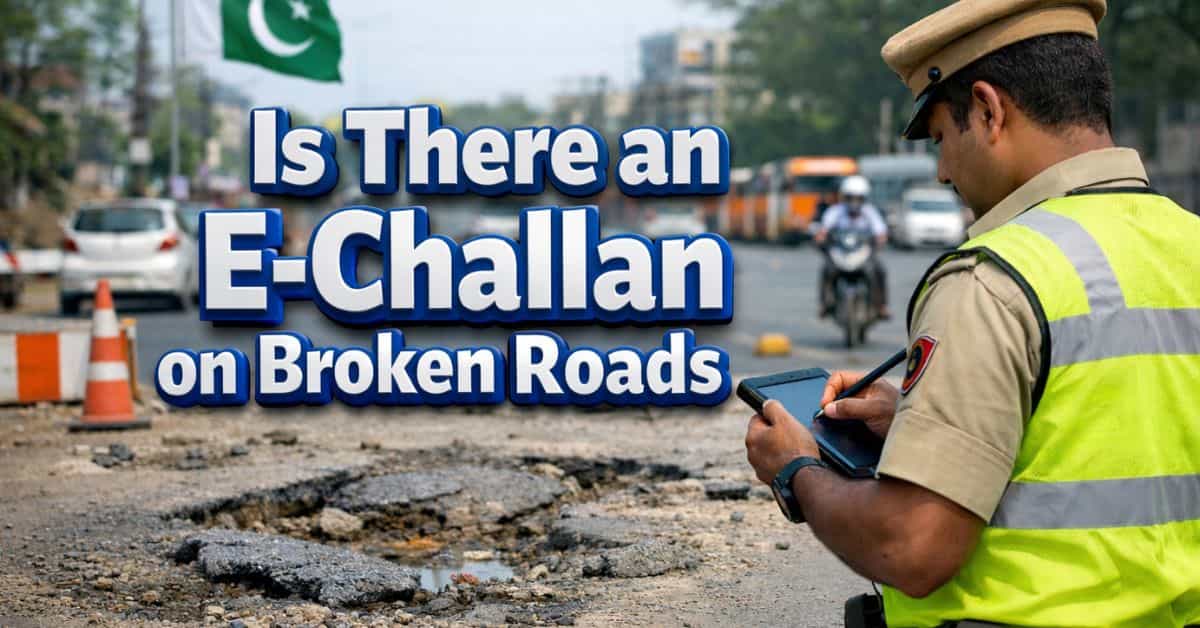
The E-Challan on Broken Roads has elicited significant public concern in urban and semi-urban areas. Citizens are increasingly questioning the justification of automated traffic penalties in light of the fact that road conditions themselves contribute to violations. Many drivers contend that penalties are unjust and disconnected from the realities of the road, as craters, damaged lanes, faded markings, and poor drainage have become increasingly prevalent.
The debate regarding whether drivers should be fined when broken roads compel them to violate traffic rules intensifies as governments expand digital traffic enforcement to enhance discipline.In this article, the issue is thoroughly examined, with a focus on public concerns, legal perspectives, and potential solutions.
What Is an E-Challan and How Does It Work?
An E-Challan is a digital traffic sanction that is issued through automated systems, including surveillance cameras, speed cameras, and number-plate recognition technology. The sanction is registered against the vehicle owner and can be verified online by using the vehicle number or CNIC once a violation is identified.
The system aims to:
- Decrease the prevalence of corruption
- Enhance transparency
- Efficiently enforce traffic legislation
- Reduce the amount of human interaction.
Nevertheless, the system frequently neglects to account for road conditions, which has become a significant source of disagreement.
Why Broken Roads Force Rule Violations?
Numerous traffic violations are not the result of irresponsible driving, but rather of inadequate infrastructure, such as:
- Potholes that are particularly deep
- Road surfaces that are uneven
- Lane markings that are either missing or diminished
- Streets that are saturated with water
- Sudden road closures without proper signage
Drivers often have no choice but to:
- Crossing lane markers
- Sudden deceleration
- Unsafely altering paths
- Utilize paths that are restricted.
However, the E-Challan system records violations without context, which results in resentment and frustration.
Check Also: Punjab Relief Students on Traffic Crackdown
E-Challan on Broken Roads: Citizens’ Main Concerns
1. Lack of Context in Automated Systems
Automated cameras cannot assess:
- Road damage
- Emergency maneuvers
- Construction zones
- Missing traffic signs
This results in unchecked enforcement, in which drivers are penalized by technology regardless of their circumstances.
2. Unfair Financial Burden on Citizens
Many households experience financial strain as a result of repeated penalties, particularly when violations are unavoidable due to road damage.
3. Accountability Gap Between Authorities
Citizens ask:
- Who is responsible for unsafe roads?
- Why are drivers penalized while authorities face no consequences?
- Why is enforcement prioritized over infrastructure repair?
Legal and Ethical Questions Around E-Challan Enforcement:
Is It Legal to Fine Drivers on Damaged Roads?
Traffic laws are legally enforced regardless of the state of the road. Nevertheless, ethical enforcement necessitates:
- Proper signage
- Safe road design
- Clear lane markings
Penalties may contravene the principles of natural justice in the absence of these.
Right to Fair Enforcement
Citizens argue that:
- Enforcement must be reasonable.
- Minimum safety standards must be met by infrastructure.
- Penalties should take into account mitigating circumstances.
Public Reaction: Social Media and Civic Pressure
The issue of E-Challan on damaged roads has acquired momentum in the following areas:
- Social media platforms
- News debates
- Citizen forums
Common demands include:
- Fines for damaged roads are suspended.
- Location audit of surveillance cameras
- Transparency in traffic management policies
- Mechanisms for public complaints
Impact of Broken Roads on Road Safety:
Ironically, broken roads increase:
- Accident risk
- Sudden braking incidents
- Pedestrian danger
- Vehicle damage
The purpose of E-Challan systems is defeated when drivers prioritize avoiding potholes over traffic regulations, resulting in a decline in road safety.
Technology vs Ground Reality: The Enforcement Gap
Why Smart Systems Need Smart Policies
Digital enforcement is both modern and efficient; however, it necessitates the following:
- Monitoring of road conditions in real time
- Temporary suspension of enforcement in areas that have been damaged
- Artificial intelligence systems that detect unusual driving behaviors
Technology becomes punitive rather than preventive in the absence of these enhancements.
What Citizens Want: Practical Solutions
E-Challan systems are not being wholly rejected by citizens. Conversely, they advocate for equilibrium:
Suggested Reforms
- No E-Challan issuance is permitted in zones that are currently under construction.
- Conducting routine assessments of the conditions of the roads in the vicinity of camera locations
- Grace periods following road damage or rainfall
- A straightforward online appeal procedure that incorporates photographic and video evidence
- Tools for public reporting of damaged highways
Government Responsibility: Roads Before Rules
Traffic discipline cannot exist without:
- Safe roads
- Visible markings
- Functional signals
- Clear signboards
Citizens are of the opinion that stringent enforcement should be implemented prior to infrastructure development, rather than the other way around.
Future of E-Challan Systems: What Needs to Change
To regain public trust, authorities must:
- Incorporate data regarding road conditions into enforcement systems.
- Enable automated fine evaluations.
- Publish transparency statistics
- Participate in citizen feedback.
The state and the public both benefit from an impartial system.
Conclusion:
The debate regarding E-Challan on damaged roads is not about opposing law enforcement; rather, it is about fairness, accountability, and logic. The purpose of digital enforcement is undermined and trust in governance is undermined by penalizing citizens for navigating hazardous roads.
E-Challan systems must be successful if roads are repaired first, and enforcement must be transparent, contextual, and humane.
Frequently Asked Questions:
1. Can an E-Challan be legally issued on a broken or damaged road?
Yes, under existing traffic laws, E-Challans can be issued regardless of road condition. However, legal validity does not always equal ethical fairness, especially when poor infrastructure directly causes the violation.
2. Can I challenge an E-Challan issued due to bad road conditions?
In many cities, you can file an online appeal through the traffic police portal. Submitting supporting evidence such as photos, videos, or location details of the damaged road improves the chances of review, though appeal systems remain limited in scope.
3. Why don’t automated systems consider road conditions?
Most E-Challan systems rely on fixed cameras and predefined rule triggers. They lack real-time infrastructure data and contextual judgment, which makes them efficient but insensitive to ground realities like potholes, flooding, or missing signage.